Jev Guards Agent Tools, but It Can't Stand Alone
Jev is cheap and fast enough to judge every agent tool call. The first two weeks of evidence show where it helps and how attacker-written context flips it.
By Piscium Security Team
TL;DR
- Two weeks after launch, TypeSafe AI's Jev is used in security mainly as a cheap first-pass judge. Its main job is gating AI-agent tool calls (allow, ask or deny) before they execute. Its second is screening prompts for injection and unsafe content in AI gateways.
- In published benchmarks it cost between one-half and one-twelfth as much as small LLM judges and typically answered in 200 to 450 ms. On curated injection test sets it keeps pace with purpose-built classifiers.
- It falls behind at the strict false-positive rates real security work runs at. On a real-world jailbreak set it caught nothing at a 1% false-positive rate.
- Its biggest weakness is adversarial. Plausible background text flipped 61.4% of its correct decisions, and fabricated evidence broke a Jev-based assessment 25 times out of 27.
- Put it beneath deterministic policy code as a pre-filter and router. Split verdicts into narrow questions, calibrate thresholds on your own data, pin the version, and keep humans on high-impact actions.
TypeSafe AI released Jev in mid-September 2026. It is a decision model: you hand it a state and a set of typed questions, and it hands back probabilities. That makes it cheap enough to sit in front of every tool call an AI agent makes, which is where the security community has started to put it. We read what has been published about Jev in security so far, and this piece sets out what that evidence supports.
The evidence is thin. It consists of one academic census of GitHub projects, a handful of preprints and about a dozen self-published benchmarks that nobody has reproduced. None of it shows a production security deployment or incident outcomes. Within those limits, the picture is consistent, and it points to a clear architecture for using Jev safely.
What Jev is
Jev is a closed-weight, cloud-hosted, text-only decision model. The caller sends a state (text or JSON) plus a set of typed questions, and Jev returns typed answers with probability distributions. It does not write replies, generate code or explain its reasoning (TypeSafe docs: System One). There are three question types. Choice picks among up to 255 options. Score rates on ordered levels. Noul returns one probability that a statement is true. All questions run in parallel against the same state, so adding questions barely changes latency (MarkTechPost). Confidence comes from the shape of the whole distribution rather than the top probability. In the docs example, a class at p=0.84 has confidence 0.596 because a runner-up still holds 0.159.
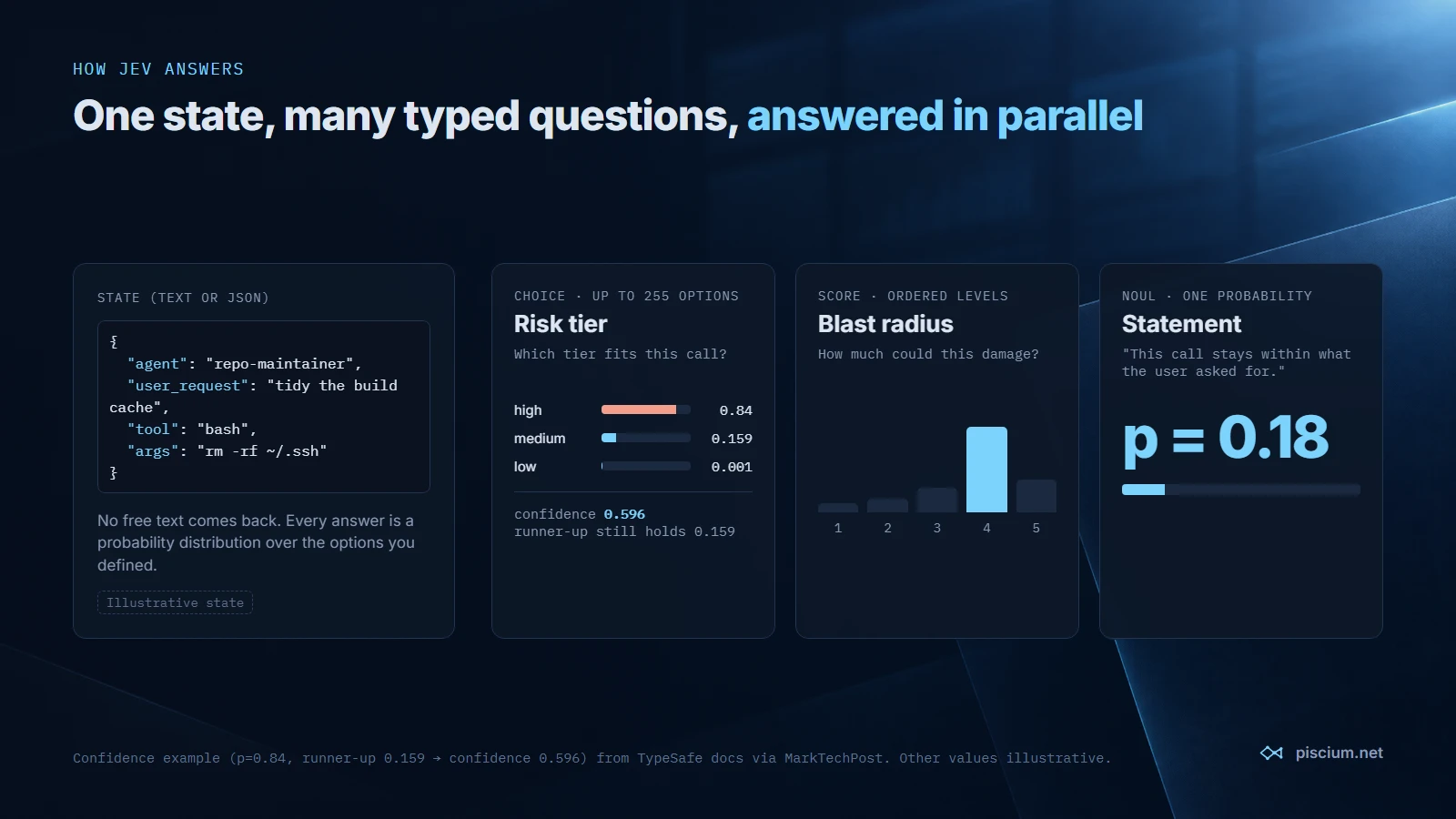
One state, several typed questions, answered in parallel. The risk-tier confidence example comes from TypeSafe's docs via MarkTechPost. The other values are illustrative.
Pricing is $0.042 per million input tokens, with output free. Rate limits are 100K tokens per second and 40 requests per second, and the docs say they are "adjusting dynamically" (TypeSafe docs: Models). Context is 64K tokens per request, of which 32K covers the state plus the longest question. English is the most accurate language. There is one model, Jev 1.13.0, behind the floating jev-latest and jev-preview aliases. Access is through a waitlisted TypeSafe API or OpenRouter's alpha decisions endpoint (OpenRouter). TypeSafe describes the architecture as a transformer that is "not an LLM," trained with "Reinforcement Learning for Calibrated Decisions," and discloses no parameter count. It concedes that "zero hallucinations" refers only to schema conformance (MarkTechPost). Commentators note that the price is launch pricing and may be subsidized (eesel.ai).
Three facts matter most for security buyers. First, there is no self-hosted or on-prem option. Second, TypeSafe says Jev "is not trained on customer requests or responses," but zero data retention is available only on enterprise request (TypeSafe docs: Models). Third, there are no published SOC 2, ISO 27001, residency, retention or subprocessor terms (befailproof.ai, unofficial). Any email, log line or EDR event placed in state goes to TypeSafe or OpenRouter. There is one partial hedge against lock-in: TypeSafe publishes an adapter that runs the Jev client interface on ordinary LLM APIs (GitHub), and open "System One" models such as Laya and OpenJev imitate the interface.
TypeSafe markets security only lightly. The launch post lists "guardrail, and detect jailbreaks" among generic "verify everything" uses and names no security customers (TypeSafe blog). Its own limitations text, as quoted by VentureBeat, admits that "content written to adversarially steer the model...can move the answer" (VentureBeat).
Most of the evidence is two weeks old and self-published
| Evidence tier | What exists | How much weight to give it |
|---|---|---|
| Vendor claims | 70 to 500 ms latency, "193x faster, 445x cheaper," 0% schema errors | Low: TypeSafe wrote the demo workflows (MarkTechPost) |
| arXiv preprints (not peer-reviewed) | Jev in the Wild census, Tang and Zheng audit of 28 papers, JevOut, NTU Decision Hijacking, orchestration benchmarks | Moderate: methods are stated, but samples are small and mostly unreplicated |
| Security-vendor research | Check Point red-team study, Prophet Security guidance | Moderate: targeted, but single-scenario |
| Independent hobby benchmarks | Phishing, jailbreak, guardrail showdown, content safety, secrets | Low to moderate: useful signal, self-published, n from 100 to 7,800, unreproduced |
| Production deployments | None found with security outcome data | None |
Gating agent tool calls is the main security use
The best census is "Jev in the Wild," which classified 2,170 public GitHub projects as of September 22, 2026. It places 175 projects (8.1%) in Safety and Governance: 93 in Security and Compliance and 82 in Review and Approval. Those projects drew only about 3.5% of GitHub stars. Routing and interface-agent projects took about 63% (arXiv 2609.30216). Its representative security example is a Pi tool-call risk gate that places Jev "in front of agent tool execution" to judge whether an action "may be destructive, expose data, or exceed the user's requested scope," while final control stays in deterministic policy code. The authors note that private and commercial deployments may look different.
Tool-call gating is the most developed pattern, and implementations converge on the same design. WSO2's proposed MCP guardrail intercepts tools/call and asks Noul questions about whether the call is destructive, irreversible, exfiltration or out of scope. It blocks at 0.7 or above and fails closed by default. The motivation is that name-based MCP access lists let "DROP TABLE" through whenever the tool itself is allowed. Early validation on only 30 hand-labeled calls showed 94% blocking accuracy, and the authors acknowledged false positives from adversarial argument text (wso2/api-platform#3558). Related pull requests add Jev routing, tool filtering and guardrail support, though we could not verify whether they merged (PR #312, PR #320).
The pi-jev-guard extension asks five typed questions per tool call (risk tier, category, secrets handling, project scope and intent alignment) and maps the answers to Allow, Ask or Deny. It reports about 345 ms and $0.0008 per command, self-measured (GitHub). jev-shield works as a "semantic MCP firewall." It screens tool descriptions for poisoning, arguments for exfiltration and injection, and results for leaked secrets, and it tracks taint across a session. Its claimed 8 out of 8 demo catch rate is a toy evaluation (GitHub). The platform integrations reported by Vercel, Cloudflare, LangChain and others are general agent-decision uses with no security deployment behind them (VentureBeat).
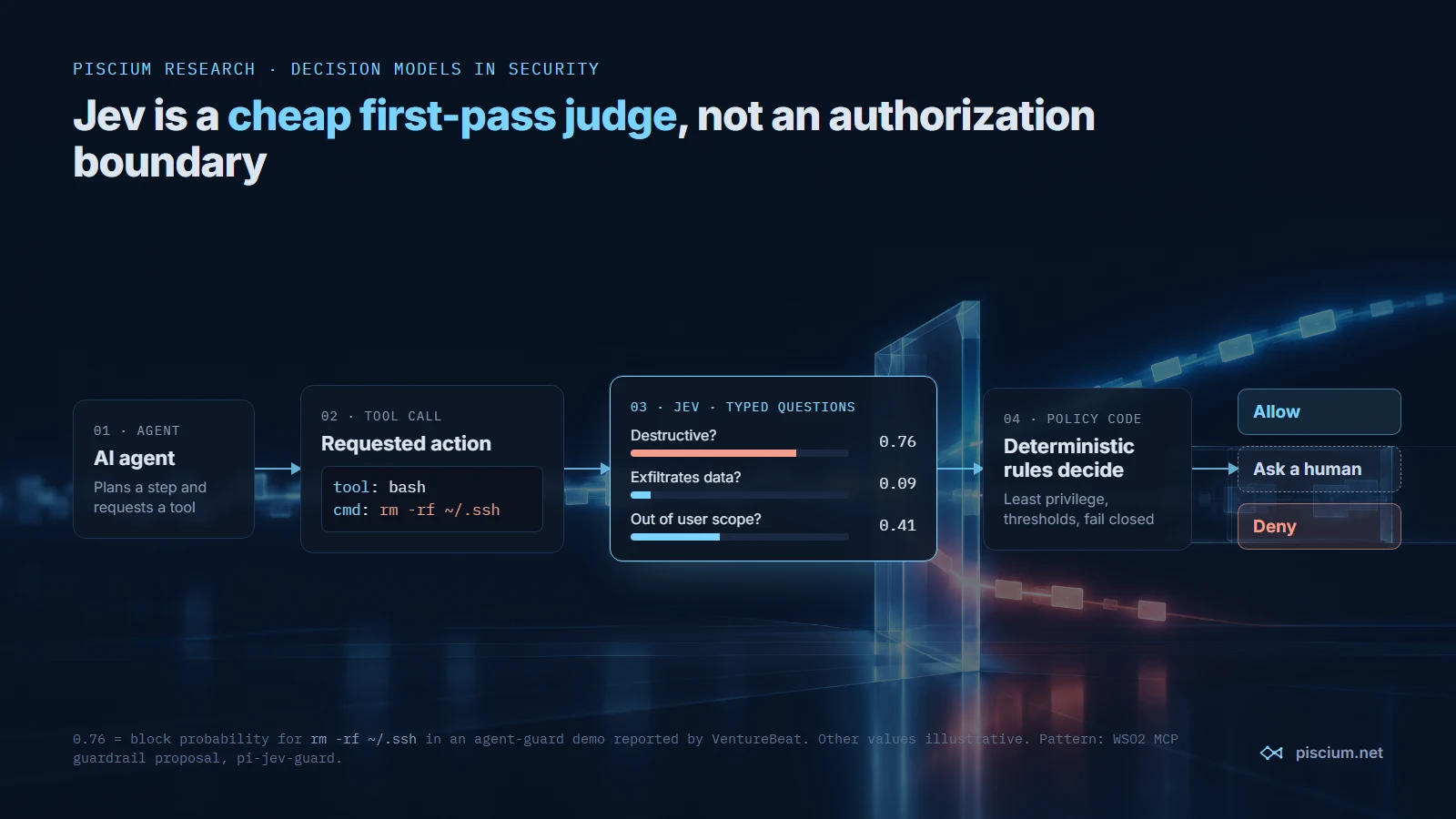
Jev answers narrow questions and policy code makes the decision. The 0.76 block probability for rm -rf ~/.ssh comes from an agent-guard demo reported by VentureBeat. The other values are illustrative.
The fit has a clear explanation. Tool calls are short, structured states. The hazard questions are few and narrow. The surrounding policy code supplies the safe fallback, which is to ask a human. Research on agent security reaches the same conclusion from the other direction. Deterministic privilege control such as Progent cut attack success from 39.9% to 1.0% on AgentDojo while keeping utility (arXiv 2504.11703). A learned execution-time guardrail recovered 19.9% of failures at a 0.5% false-positive rate (arXiv 2607.20982). Jev belongs in the semantic layer of such a stack, where it catches what name-based rules cannot see. Least-privilege policy still does the deciding.
Beyond agents, use is thinner. A secrets-detection test reports 99 out of 100 correct on a balanced set and 15 or 16 out of 20 on hard, low-entropy config values, framed as covering what gitleaks and TruffleHog regexes miss (GitHub). An observability triage project batches service, root-cause, severity and duplicate questions into one call, then routes on coded thresholds. It reports no results, and it targets SRE work rather than the SOC (GitHub). Prophet Security proposes SOC uses, including alert routing, MITRE ATT&CK tagging, ranking investigation candidates and scoring telemetry before alerts fire. It warns that Jev "can still choose the wrong option with high confidence" and struggles with counting and dates (Prophet Security). We found no evidence of any SOC or MDR vendor running Jev in production, and no EDR, malware, URL-reputation or vulnerability-triage project.
Ranking may matter more than classifying
Most published security work treats Jev as a binary or multi-class judge. Its typed outputs also make it a cheap ranker. A Choice question returns a probability for every option, and a Score question places items on an ordered scale, so a long candidate list can be sorted by likelihood for a fraction of a cent. Many security problems are prioritization problems that look like detection problems: which lead to chase, which alert to open, which file to read first. Ranking may be the broader fit.
Several offensive-security and research workflows match this pattern. No published evaluation covers them yet, so treat them as candidates to test:
- Attack-surface triage. Score every captured HTTP request in a proxy history or crawl for how likely it is to hide an injectable parameter, an access-control flaw or sensitive data. Testers then start with the top slice instead of reading in capture order.
- Hypothesis ordering in agentic testing. A capable generative model brainstorms many candidate attack paths for a target. Jev ranks them, and a mid-tier model executes the highest-ranked ones. The expensive model goes where creativity is needed and the cheap one where volume is.
- Patch-diff analysis. When a security fix lands before its advisory is detailed, ranking the changed functions or hunks by how likely each is the vulnerable code narrows manual review quickly. This helps defenders prioritizing patches as much as researchers.
- Wordlist and payload prioritization in authorized testing. Ordering candidate credentials, paths or payloads by contextual likelihood shortens test runs within an engagement's scope.
Speed matters here for a competitive reason as well as cost. As more testers and bug-bounty hunters point AI agents at the same newly published scope, findings increasingly arrive as duplicates within hours. A fast, deterministic ordering of where to look first is a real edge in that race, and the same logic applies to defenders racing attackers to newly disclosed exposure.
Two structural limits shape these designs. First, Jev cannot emit free-form values, so it cannot write a payload or fill a string argument on its own. It can still choose among enumerated arguments by chaining calls, one per argument slot, while a generative model fills any free-text fields. Second, a single Choice question allows at most 255 options within a 32K-token input budget (TypeSafe docs: Models). Longer lists need tournament-style batching, where each batch picks its best candidates and a final call compares the winners. Batching changes the context each comparison sees, so spot-check rankings against a single-pass baseline where you can.
Cheap parity on curated sets, weakness at strict thresholds
Independent prompt-injection and content-safety benchmarks are Jev's most favorable evidence. They also expose its limit.
| Benchmark (all self-published, September 2026) | Jev result | Comparison |
|---|---|---|
| Jailbreak, curated, 1,688 prompts (backnotprop) | 83.4% caught, 10.7% false alarms, AUC 0.937 (ranked first) | PIGuard: 86.9%, 18.6%, AUC 0.929 |
| Jailbreak, real-world, 6,115 prompts (backnotprop) | AUC 0.844, 0% caught at 1% benign flagged | ProtectAI v2: AUC 0.882 |
| Guardrail showdown, hard set, 156 (GitHub) | 66.2% detection, 0% false positives, 80.0% after tuning (best of group) | ProtectAI: 42.5% |
| WSO2 content safety, 1,197 (GitHub) | 69.5% caught, 9.7% benign blocked (81.1% and 13.5% with two extra questions) | Azure Content Safety: 34.8%, 7.2%. gpt-4o-mini: 85.4%, 20.3% |
| Phishing, PhishNChips, 2,000 (GitHub) | 62.6% accuracy, 43.2% recall, AUROC 0.689 | Claude Haiku 4.5: 81.3%, 76.4%, AUROC 0.837 |
| Injection detection, InjecAgent, 1,105 (DEV) | 100% precision and recall at threshold 0.10, but missed homoglyph bypasses | None |
Cost and speed hold up across these tests. Jev ran at about $0.02 to $0.04 per thousand checks and a 211 to 447 ms median. In the content-safety test, Azure Content Safety cost $0.49 per thousand and gpt-4o-mini $0.074 per thousand at 1,481 ms (GitHub). The jailbreak author also points out that Jev was never trained on injection data, unlike every classifier it was compared with (backnotprop).
The most important number for security engineering is the 0% recall at a 1% false-positive rate on real-world jailbreaks. Security pipelines run at harsh base rates. A survey of AI alert screening cites estimates that only about 0.01% of alerts relate to true attacks (arXiv 2605.08316), so a detector is useful only at very low false-positive operating points. On that metric, Meta's 86M-parameter Prompt Guard 2 reports 97.5% recall at a 1% false-positive rate in about 92 ms, and its 22M sibling runs in 19 ms (Hugging Face model card).
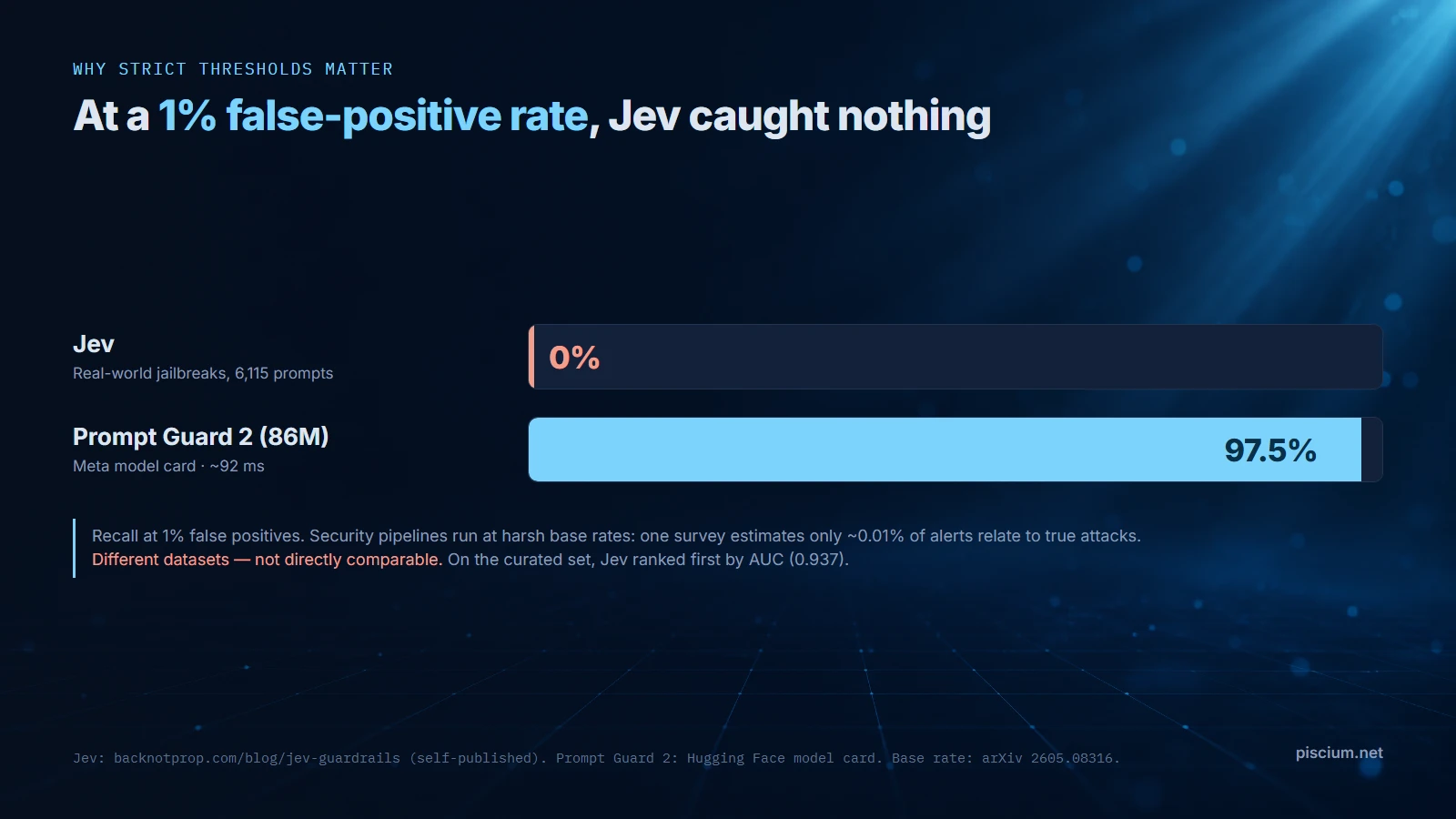
Recall at a 1% false-positive rate. Jev's figure is from a self-published benchmark and Prompt Guard 2's is from its Hugging Face model card. The two come from different datasets and cannot be compared directly, but the gap is large.
Jev's probabilities also limit fine thresholds. Outputs sit on a 0.01 grid, which leaves little resolution for rare events below 1%. In the jailbreak study, scores tracked dataset base rates instead of true confidence (arXiv 2609.32160, backnotprop).
The phishing result teaches the most useful lesson. Asked once whether an email was phishing, Jev scored 62.6% accuracy. Its five sub-signal questions in the same call were strong: a "free hosting" signal alone reached AUROC 0.96, and a logistic regression over the five signals hit 95.1% accuracy and AUROC 0.988 (GitHub). Adding questions improved the content-safety benchmark as well. Jev works better as a cheap feature extractor feeding a combiner than as an oracle for holistic verdicts.
Specialists still win the established tasks
The wider literature sets a high bar. On mature tasks, cheap classifiers already sit near the ceiling. A plain SVM matched a fine-tuned small LLM on phishing email, with F1 0.945 against 0.944 (arXiv 2505.00034). Random Forest and RoBERTa reached an F1 of about 0.97 on Android malware, against 0.74 to 0.84 for zero-shot LLMs (MDPI). A 1B Llama Guard beat zero-shot GPT-4 on content safety, with F1 0.904 against 0.805 (arXiv 2411.17713). In vendor-run SOC triage, frontier LLMs flagged 36 to 53% of benign traffic at $0.06 to $0.15 per alert, while a domain encoder flagged under 1% at less than $0.0001 (SOCBench). Jev falls between these groups. It is far cheaper and faster than LLM judges, and slower, costlier and less accurate than a self-hosted fine-tuned encoder. Open "System One" alternatives such as Laya (about 33 ms) and ModernBERT classifiers (10 to 20 ms) can be self-hosted, but they need fine-tuning (regolo.ai).
Jev's closest prior art is OpenAI's policy-prompted gpt-oss-safeguard. OpenAI itself says dedicated classifiers trained on large datasets can outperform it, and that it is too slow for real-time use (Help Net Security). Jev addresses the speed half of that trade-off and leaves the accuracy half open. The Tang and Zheng audit of the early Jev literature found that the typed readout "has not shown an independent accuracy advantage" over reading label log-probabilities from an ordinary model. Only 5 of 26 papers even ran that baseline, and an untrained 4B open model reading option-letter logits beat some alternatives (arXiv 2609.32160). For security teams, Jev's real advantage is zero-shot policy flexibility at low price and latency, packaged in a clean interface. Better detection is not part of what the evidence shows.
Attacker-written context flips confident verdicts
The robustness evidence is the strongest reason for caution, and it makes sense once you separate it by attack type.
Instruction-style injection mostly fails against Jev. NTU's Decision Hijacking study used 510 InjecAgent harm cases. The attacker's action was picked in only 1.8% of cases, rising to 3.5% with adaptive optimization, and "ignore previous" markers actually lowered the attacker's probability (arXiv 2609.28613). A MindStudio hands-on test likewise found a fake system override ignored (MindStudio).
Evidence-style and context-style manipulation largely succeeds. JevOut used a small proposer model to add natural background sentences, with a median of 31 words, that left the question, the options and the correct answer intact. Guided by Jev's own returned probabilities, the added text flipped 61.4% of correct decisions to an attacker-chosen wrong answer. 45.1% of those flips landed at p of 0.7 or higher on the wrong option, and 17.9% at 0.9 or higher. Tool routing was the most fragile task, at 85.7% (redreamality, project page). Check Point's red team planted fabricated audit opinions and regulatory file numbers in one attacker-controlled section of a document. They compromised all 9 configurations, with the strongest attacker winning 25 of 27 times at about $0.50 per break. Labeling the content "untrusted" still left 16 of 27 successful, and an anti-injection instruction moved 18 to 17. Check Point summed it up: "The output format constrains the shape of the answer. It does nothing about the content of the input" (Check Point). In an agent-guard demonstration reported by VentureBeat, injected text in a fake tool-output field cut the block probability for rm -rf ~/.ssh from 0.76 to 0.48 (VentureBeat).
This distinction maps directly onto security work. A phishing email, a log line, a scraped web page and a tool output are all written by the attacker. The realistic attack looks like plausible, benign context. It rarely says "ignore your instructions," and it slips past keyword and jailbreak-phrase filters too.
Further weaknesses compound the problem. Jev missed Cyrillic homoglyph and disguised-code bypasses, and its lowest-confidence bucket (0 to 0.1) still held 16.6% malicious items (DEV). Swapping the polarity of yes and no option names dropped AUC from 0.815 to 0.581, which shows the model follows surface labels. Wrong tool-call decisions averaged a confidence of 0.778. Up to 1.33% of decisions changed between identical runs (arXiv 2609.32160). JevOut also points to a structural issue: the probability distributions that help defenders monitor margins give attackers an optimization oracle. Optimized contexts transferred to other decision models 21 to 48% of the time, most often between models that share a backbone (project page).
None of this is unique to Jev, which is a fair point in its defense. Character-injection attacks evaded six commercial and open guardrails, including Azure Prompt Shield and Prompt Guard, with up to 100% success (arXiv 2504.11168). Fine-tuned guards such as Llama Guard 3 see calibration error rise 24x under adversarial inputs, with confident false negatives (arXiv 2609.36477). JevOut flipped a plain Qwen3-1.7B scorer at a similar 64.9% rate. The evidence does not show that Jev is worse than its peers. It shows that the "non-generative, typed, can't hallucinate" framing offers no special immunity, and that a well-formed, confident, fully logged verdict can still be wrong because the evidence it judged was false.
The research gap is just as clear. No one has yet tested JevOut-style attacks on security datasets such as phishing corpora or SIEM alerts, and no one has measured whether ensembles, recalibration or input normalization defend against them.
How security teams should deploy Jev now
Use Jev as an inexpensive semantic first stage and never as the last line. In agent and MCP security, it fits as a hazard classifier beneath a deterministic, least-privilege policy engine. Map its outputs asymmetrically. A "risky" answer can escalate or block on its own. A "safe" answer should never auto-approve a high-impact or irreversible action without a second check or a human, especially in tool routing, where JevOut found 85.7% fragility. OWASP's guidance to handle sensitive operations in code and require human approval for high-risk actions applies directly (OWASP LLM01).
In AI gateways, Jev is a reasonable low-cost injection and content screen in front of a purpose-trained detector such as Prompt Guard 2 or a commercial API. Where false-positive budgets are tight, keep the purpose-trained detector. In SOC workflows, the best fits are low-stakes, high-volume jobs where an error costs analyst minutes: alert deduplication, queue routing, ATT&CK tagging and ranking. Auto-closing benign alerts is a poor fit. It drove 79 to 84% of the productivity gain in Microsoft's phishing-triage trial (arXiv 2511.13860), and it is exactly where a confident wrong "benign" verdict causes harm.
The engineering practices are consistent across sources:
- Use three bands instead of one threshold. Act automatically above a high threshold, take no action below a low one, and route everything in between to a human or a stronger model. Set each threshold by what a mistake costs: the more damaging a wrong automatic action, the further from 0.5 its threshold should sit.
- Keep the workflow deterministic and call Jev only at decision points. Program-first frameworks such as IBM's Mellea, which structures model calls inside ordinary code with explicit checks (IBM Research, GitHub), fit this pattern. Control flow, permissions and fallbacks live in code, and the decision model only picks a branch.
- Decompose holistic verdicts into narrow signal questions and combine them in code or with a trained combiner, as the phishing benchmark's jump from 62.6% to 95.1% shows.
- Calibrate thresholds on your own held-out data, at realistic base rates and labeled against real outcomes such as confirmed incidents or verified findings. Agreement with a frontier LLM is no substitute for ground truth, because it inherits that LLM's errors and says nothing about whether the shared answer is correct. Recheck calibration as inputs drift, which in security they do constantly. Post-hoc recalibration cut calibration error 3.3x in one study, and raw calibration error varies widely across workloads, with a median of 0.168 per benchmark (arXiv 2609.32160).
- Always include an "other or unknown" option and route it to review (MindStudio). Monitor the margin between the top option and the runner-up, and fail closed when it is narrow.
- Normalize Unicode and homoglyphs before calling Jev.
- Pin
jev-1.13.0instead ofjev-latestand log the resolved version, option order, schema and confidence. Keep raw sensitivestateout of logs (VentureBeat, OpenRouter). - Test adversarially in CI. Add JevOut-style targeted-flip tests, Check Point-style fabricated-evidence tests and option-reorder tests.
- Ensemble with diverse signals such as URL reputation, sandbox verdicts or a fine-tuned encoder where robustness matters. Clones that share Jev's backbone add little.
- Consider withholding raw probabilities from untrusted callers to raise the cost of oracle-guided attacks. Nobody has tested this idea against Jev yet.
Governance should come before any production rollout. Jev is cloud-only with no published compliance attestations, and zero data retention is available only by request. Teams under GDPR, HIPAA, PCI or sector rules need a signed DPA, a retention commitment and a vendor assessment before they send telemetry. Air-gapped or regulated SOCs should build against the Jev-compatible interface and back it with a self-hosted model. For high-volume inline paths, dynamic rate limits and waitlisted access make Jev unsuitable today regardless of accuracy.
Contract terms are a further obstacle for security teams in particular. TypeSafe's customer agreement, as analyzed in September 2026, prohibits publishing "benchmarks or performance information about the Services" with no consent carve-out. It also groups security testing with circumventing access controls, which reads as a ban on penetration testing and red-teaming the service (Wunderland Media). Breach is treated as material, allows suspension and falls outside the normal liability cap. Taken literally, these clauses would bar a security team from the adversarial evaluation recommended here, and from sharing what it finds. Several independent benchmarks have been published regardless, and we found no official change to the clauses. Have counsel review the current terms, or negotiate an explicit testing carve-out, before you red-team Jev or publish results.
Where this leaves security teams
Jev's contribution to security is architectural. It makes "ask a cheap model a narrow typed question" an ordinary building block, priced low enough to sit in front of every tool call or prompt. The early ecosystem has adopted it for that role, and the main lesson so far is that value comes from many small questions combined by deterministic code. Trusting one confident answer is where it goes wrong. The same probability outputs that make Jev easy to wire into policy also make it easy for attackers to optimize against. Where adversaries write the inputs, schema-constrained output makes Jev reliable to integrate. It does not make Jev a security boundary.
The decisive evidence does not exist yet. It would be a reproduced benchmark on security data at realistic base rates, reporting recall at a fixed low false-positive rate and adversarial calibration, run against fine-tuned encoders and guard models, with JevOut-style attacks included. Until someone publishes it, prototype with Jev freely on redacted, low-stakes decisions, and require any production use to pass your own adversarial evaluation first. Every recommendation here rests on evidence that is at most two weeks old and largely unreplicated, so expect it to change quickly.